
These Machines Can Put You in Jail
A million Americans a year are arrested for drunken driving, and most stops begin the same way:
flashing blue lights in the rearview mirror, then a battery of tests that might include standing on one foot or reciting the alphabet.
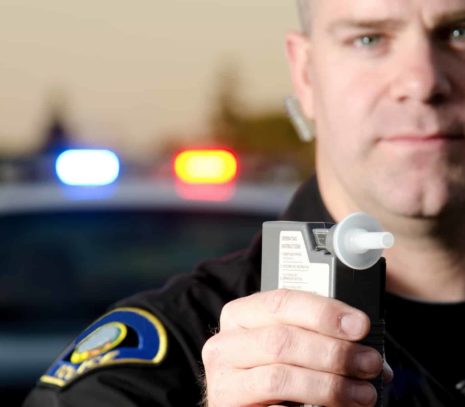
What matters most, though, happens next. By the side of the road or at the police station, the drivers blow into a miniature science lab that estimates the concentration of alcohol in their blood.
If the level is 0.08 or higher, they are all but certain to be convicted of a crime.
But those tests — a bedrock of the criminal justice system — are often unreliable, a New York Times investigation found.
The devices, found in virtually every police station in America, generate skewed results with alarming frequency, even though they are marketed as precise to the third decimal place.
Judges in Massachusetts and New Jersey have thrown out more than 30,000 breath tests in the past 12 months alone, largely because of human errors and lax governmental oversight. Across the country, thousands of other tests also have been invalidated in recent years.
The machines are sensitive scientific instruments, and in many cases they haven’t been properly calibrated, yielding results that were at times 40 percent too high.
Maintaining machines is up to police departments that sometimes have shoddy standards and lack expertise.
In some cities, lab officials have used stale or home-brewed chemical solutions that warped results. In Massachusetts, officers used a machine with rats nesting inside.
Technical experts have found serious programming mistakes in the machines’ software.
States have picked devices that their own experts didn’t trust and have disabled safeguards meant to ensure the tests’ accuracy.
The Times interviewed more than 100 lawyers, scientists, executives and police officers and reviewed tens of thousands of pages of court records, corporate filings, confidential emails and contracts.
Together, they reveal the depth of a nationwide problem that has attracted only sporadic attention.
A county judge in Pennsylvania called it “extremely questionable” whether any of his state’s breath tests could withstand serious scrutiny. In response, local prosecutors stopped using them.
In Florida, a panel of judges described their state’s instrument as a “magic black box” with “significant and continued anomalies.”
Even some industry veterans say the machines should not be de facto arbiters of guilt.
“The tests were never meant to be used that way,” said John Fusco, who ran National Patent Analytical Systems, a maker of breath-testing devices.
Yet the tests have become all but unavoidable. Every state punishes drivers who refuse to take one when ordered by a police officer.
The consequences of the legal system’s reliance on these tests are far-reaching.
People are wrongfully convicted based on dubious evidence. Hundreds were never notified that their cases were built on faulty tests.
And when flaws are discovered, the solution has been to discard the results — letting potentially dangerous drivers off the hook.
A man backed his car into an 83-year-old woman outside a liquor store and then failed field sobriety tests.
Another man was stopped after vomiting out the window and veering “all over the road.”
One more driver, with a suspended license, was pulled over and blew a 0.32 — a level of drunkenness that would leave most people unconscious.
All three were arrested and charged with driving drunk.
All three had previous convictions for driving while intoxicated, according to police reports and court records.
And all three were acquitted after Massachusetts was forced to throw out their breath tests — along with more than 36,000 others — in one of the largest exclusions of forensic evidence in American history.
The Deerfield River snakes through the woods of northwestern Massachusetts, and on a hot Sunday in July 2013 it was packed with rafters.
Matthew Mottor arrived with more than a dozen friends and family members and two coolers of Blue Moon beer.
They spent hours tubing down the river and drinking before going ashore for a picnic.
That’s when a drunk woman in the group caught the eye of a Massachusetts State Police trooper patrolling the area.
The trooper, Steven Hean, told them to get their friend home.
The party over, Mr. Mottor left his girlfriend and got a ride to his truck, a few miles upriver.
He pulled his gray Dodge Durango onto the winding road.
He made it about 200 yards. Then he saw the flashing lights.
Trooper Hean wrote in a report that he stopped Mr. Mottor for driving 41 miles per hour in a 25 m.p.h. zone.
Detecting “a strong odor” of liquor on Mr. Mottor’s breath, the trooper asked him to perform some field sobriety tests, including walking heel-to-toe.
Accidents years earlier had left Mr. Mottor with metal plates in his ankles and feet, court records show.
“I explained to him that I’m not great at walking around on two feet on an everyday basis,” Mr. Mottor said.
After passing two tests — reciting the alphabet and standing on one leg — he struggled to walk in a line. Trooper Hean brought out his breath tester.
Hand-held devices, like Trooper Hean’s Alco-Sensor IV, contain fuel cells that react to the alcohol in exhaled breaths and generate an electric current — the stronger the current, the higher the alcohol level.
They are inexpensive and easy to maintain, but their results can be inconsistent.
Older women sometimes have trouble producing enough breath to get the machines to work. Toothpaste, mouthwash and breath mints — even hand sanitizer and burping — may throw off the test results.
Tests from those portable machines are not admissible in court in most states (California is among the exceptions).
But they often trigger an arrest, which leads to a test on another machine at the police station.
That result determines whether someone is charged — and, often, whether they’re convicted.
By the side of River Road, Mr. Mottor blew a 0.13, far above the legal limit. That’s when the cuffs came out.
Attempts to prevent drunken driving predate the modern automobile.
In the late 19th century, Britain had outlawed being drunk while operating a “carriage, horse, cattle or steam engine.”
In 1897, a London taxi driver named George Smith crashed his electric cab. He confessed to having had “two or three glasses of beer” and was fined 20 shillings.
It is widely regarded as the first arrest for intoxicated driving.
Near the end of Prohibition, a biochemist invented a suitcase-sized machine with vials of chemicals and a balloon to blow into.
Alcohol in the driver’s breath would trigger a reaction: the drunker the driver, the deeper the chemicals’ color.
It was called the Drunkometer.
But it was bulky and hard to use.
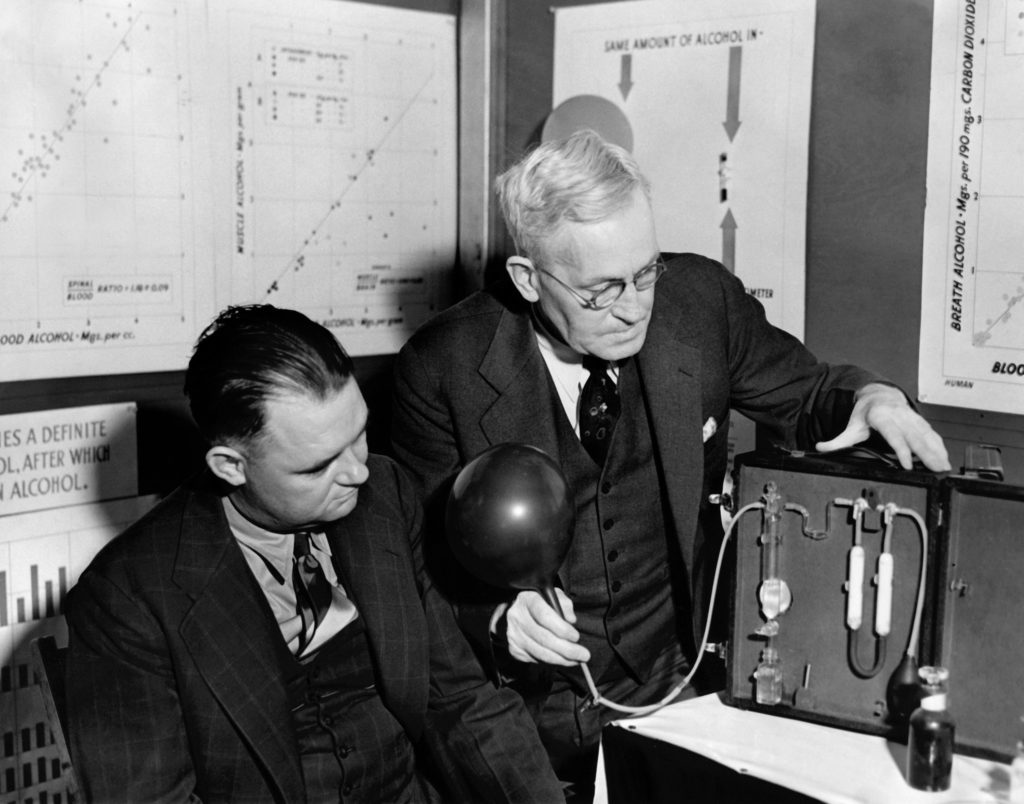
Two decades later, a police photographer and amateur chemist named Robert Borkenstein developed a similar but more portable machine.
He named it the Breathalyzer.
Police departments around the country bought Mr. Borkenstein’s invention and versions developed by competitors.
Then, in 1980, a fatal collision led to an overhaul of America’s drunken driving laws — and a sales boom for companies that made breath-testing devices.
Carime Lightner, 13, was walking to a church carnival in Fair Oaks, Calif., when a drunken driver slammed into her so hard she was knocked out of her shoes.
The man had been arrested repeatedly for intoxicated driving.
Carime’s mother started Mothers Against Drunk Driving and launched one of the most effective citizen lobbying campaigns in history.
States set stiffer penalties, including mandatory jail time in some cases, and made it illegal to drive with a blood-alcohol level above a designated mark.
The crackdown worked.
In 1982, the year the National Highway Traffic Safety Administration began keeping records, some 21,000 people were killed in drunken-driving incidents. The number of deaths tumbled to around 10,500
in the most recent annual tally, even as the number of miles driven by Americans has nearly doubled.
In most of the country, the threshold for illegal drunkenness is 0.08 grams of alcohol per 100 milliliters of blood.
The only way to measure that directly is to draw blood, which requires a warrant. Breath tests are simpler.
Testing machines can go for $10,000 or more, and some two dozen companies sell them in the United States.
The biggest contracts, with state police crime labs, are worth millions.
A St. Louis company, Intoximeters, made the portable device used on Mr. Mottor. Dräger, a German company, owns the rights to the Breathalyzer name.
CMI, based in Kentucky, is another industry leader.
“Our top priority is the quality and safety of our products,” said Brian Shaffer, a Dräger spokesman.
“Our products provide the highest level of forensic and legal integrity.”
He added, “Our advanced evidential breath alcohol testing instruments exceed the requirements of national and international regulatory agencies.”
CMI and Intoximeters did not respond to multiple requests for comment.
Shirtless and still in swim trunks, Mr. Mottor arrived at the police barracks in Cheshire, Mass. He didn’t think he was drunk.
But he was starting to panic.
He had left his phone in his S.U.V. and had no way to tell his girlfriend what had happened.
He pictured her alone by the river, thinking he had driven into a ditch.
Mr. Mottor was escorted to the station’s breath-testing machine.
It was larger, more sophisticated and in theory more reliable than Trooper Hean’s portable instrument, and its results were admissible in court.
Trooper Hean asked Mr. Mottor to start blowing. Hoping it would help him get back to his girlfriend faster, he complied.
The Alcotest 9510, manufactured by Dräger, resembles a fax machine with a small hose.
As a person breathes into the device, a beam of infrared light is shot through the sample.
Chemicals, including the ethanol in alcoholic drinks, absorb light to varying degrees.
By analyzing how much light is absorbed, the instrument can identify the type of chemical and the amount of it present.
Many machines, including the Alcotest 9510, also use a fuel-cell sensor — the same type of tool that is in portable devices.
Each system is supposed to operate independently; if both return similar results, the theory goes, it’s an extra assurance that the measurement is accurate.
Mr. Mottor blew for about 10 seconds, the machine beeped, and a number flashed on its screen: 0.08.
He was charged with operating under the influence, which leads to the automatic revocation of driving privileges in Massachusetts.
Trooper Hean confiscated Mr. Mottor’s license and called a truck to tow his S.U.V.
Breath-testing machines need less than a minute to run their calculations.
What happens during those 60 seconds, though, has been the subject of years of courtroom fights.
Defense lawyers have repeatedly tried to forensically examine the machines, especially their software.
Inspecting the code could reveal any built-in flaws or assumptions the devices use in their calculations.
But even procuring a machine is a challenge. Manufacturers won’t sell them to the public.
Jan Semenoff, a former police officer who works with defense lawyers, was once a CMI salesman and had a machine left over from those days.
When he sent it in for a repair, CMI wiped the machine’s memory chip.
“They turned the damn thing into a paperweight,” Mr. Semenoff said.
Courts in at least six states, including New York, have rebuffed defense lawyers’ attempts to get their hands on the machines’ code.
But in 2007, the New Jersey Supreme Court granted a request by defense lawyers and ordered Dräger to allow outside experts to analyze the software for the Alcotest 7110 machines in use statewide.
The experts said it was littered with “thousands of programming errors,” according to their report to the court.
After reviewing the evidence, the court deemed the Alcotest 7110 “generally scientifically reliable.”
But the state court also acknowledged the devices had “mechanical and technical shortcomings” that had the potential to produce the wrong result.
Dräger said it quickly fixed the problems, but the state never rolled out the software update, court records show.
Dräger now advertises the 7110 as the only device on the market whose software “has been reviewed by independent third parties and approved by a Supreme Court decision.”
None of that made a difference in other states, which employ a variety of machines and standards.
Each state decides how rigorously it will test machines, and several have used devices that were deemed unreliable elsewhere.
In 2005, for example, Vermont’s toxicology lab scrutinized machines from four manufacturers.
The lab rated CMI’s Intoxilyzer 8000 as “unsatisfactory” and found that it gave inaccurate results on “almost every test,” according to a lab technician’s report.
But the same device was already being used in Mississippi, and it would soon be deployed by other states, including Ohio and Oregon.
Florida, too, adopted the Intoxilyzer 8000, even after a test machine short-circuited and started to smoke, state records show.